
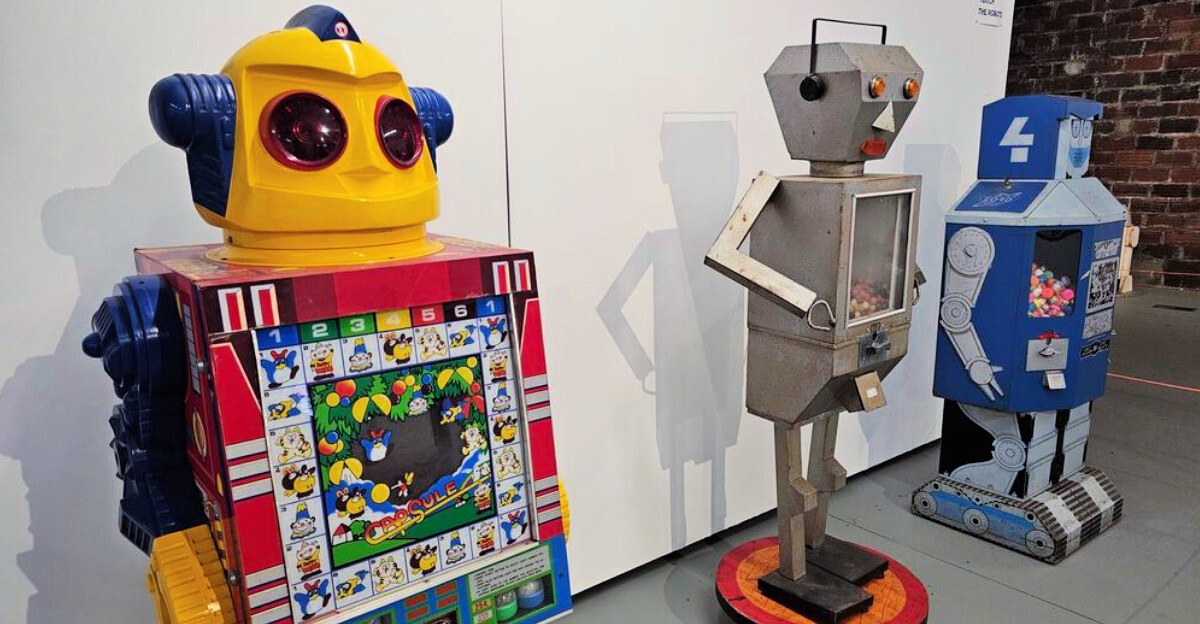
There’s no robot rebellion in Margaretville, New York, just a friendly invasion. Vintage Robots: Humanoid Visions of the Future, an exhibit by the Space Age Museum, brings together decades of droids at the Galli-Curci Theater through July 9. Paired with retro photos of kids in atomic age attire and home-built bots, the collection is a playful reminder of how the future was once imagined — and how it stacks up against the tech of today.
Hey Siri, meet your grandparents
At the entrance, a robot in mid-sprint with a paintbrush and bucket has left a warning in dripping red paint: “The humans are coming!” Square footprints mark its hasty retreat, hinting at the exhibit’s humor and attention to detail. Inside, visitors encounter dozens of robots: classic models with antennae, ones equipped to serve popcorn or candy, and several unique machines crafted from scraps and found materials.

(Sofia Misenheimer | Roam Unknown)
“The one up against the wall there — the aluminum boxy one — that one we found on eBay right after 9/11,” Peter Kleeman, curator of the exhibit and director of the Space Age Museum, tells Roam Unknown. It was one of the few robots sourced from outside his family’s usual hunting grounds in the Northeast and New England.
“My dad flew down [to Georgia] to pick it up and had to break it into pieces that could fit into different suitcases,” Kleeman explains. He ended up carrying the head in his carry-on luggage, a metallic cube with bulbous red eyes, which made for an interesting conversation given heightened airport security.

(Sofia Misenheimer | Roam Unknown)
The Kleeman family’s robot rescue mission, which started in the early ’80s, has taken them from flea markets to dumpsters. Their dedication to finding and preserving vintage artifacts at the intersection of science fiction, technology, and art has turned into a nearly fifty-year mission — one they hope will eventually result in a permanent location for the Space Age Museum.
Old robots, new thoughts
Peter Kleeman’s passion for old robots began in childhood, fueled by trips with his antique-collecting parents. “Being a kid in the early eighties who loved ET and Star Trek and Star Wars and Buck Rogers, they thought it would be fun to include me on some of their flea market adventures,” he recalls. His first acquisition was a $10 ray gun, setting him on a lifelong path of collecting.

(Sofia Misenheimer | Roam Unknown)
Their efforts have amassed around 5,000 space age relics, spanning everything from amusement park rides to period photographs and assorted ephemera. The exhibit’s slideshow offers glimpses of the collection: children in robot costumes, adults piecing together homemade machines, and mechanical figures starring in commercial settings.
Kleeman’s favorite piece on display is a 1960s robot named Gumbo that demonstrates the era’s playful approach to technology. “It was made in Italy and takes lira. The gumballs come out of robotic genitalia, which is kind of amusing,” he notes. The unusual feature captures a time when designers infused technological advances with a sense of humor, reflecting broader cultural optimism.

(Sofia Misenheimer | Roam Unknown)
More human than human
The exhibit explores the personal connections that can be made between human and machine. “Each robot has their own facial expression and body language, and I think that that really speaks to people. They’re mirrors for humans as humanoids,” Kleeman explains. That anthropomorphic quality makes retro robots relatable, bridging human experiences and mechanical functions.

(Sofia Misenheimer | Roam Unknown)
“These robots are artistic expressions of what mechanical beings could be. They represent a time when people believed they could shape the future with their own hands,” he said, pointing out a disconnect between the personable robots of the past and the more functional, sometimes intimidating robots made in modern times.
Past generations envisioned robots not just as tools, but as companions and even entertainers, whereas contemporary robots, used in manufacturing or military settings, tend to prioritize function over form and often appear faceless and menacing. That shift points to a cultural shift in our relationship with technology, Kleeman says.

(Sofia Misenheimer | Roam Unknown)
Sci-fi dreams vs. AI realities
In the 1950s, science fiction writers like Isaac Asimov and Arthur C. Clarke envisioned robots as integral parts of human society. Asimov’s famous “Three Laws of Robotics,” introduced in his 1942 short story Runaround, emphasized robots as protectors and servants of humanity, bound by ethical constraints. These narratives imagined robots with human-like qualities, capable of understanding and interacting with people on a personal level. Asimov’s robots were not just functional machines; they were companions and even moral agents, embodying a future where technology could be integrated into daily life.

(Sofia Misenheimer | Roam Unknown)
Arthur C. Clarke, in works like 2001: A Space Odyssey, depicted robots and AI as highly advanced, yet still intertwined with human experiences and emotions. Clarke’s HAL 9000, while ultimately a cautionary tale about AI, reflected the complexity and potential of artificial intelligence in understanding and interacting with humans.
AI technology, integral to many contemporary robots, raises questions about consciousness, intellectual output, and the value of machine learning versus human creativity. Kleeman points out that while his vintage robots don’t have sentience, they symbolize a time when there was optimism about technology and a belief in human ingenuity to create a better future. In contrast, AI-driven robots often replace human roles, advancing in ways that seem impersonal.
Bot to the future
The Space Age Museum hopes to inspire and educate by reflecting on how past generations envisioned the future, and by positioning these visions within the context of current technological advancements and societal changes. “We don’t just want to look back; we want to engage in a forward-thinking dialogue about where technology can take us and the ethical considerations that come with it,” said Kleeman.

(Sofia Misenheimer | Roam Unknown)
The pop-up exhibit is part of a larger ambition to establish a permanent home for the Space Age Museum. “Our main challenge is finding a large enough space where these robots can be displayed and appreciated year-round,” Kleeman shares. The vision includes not only a static display but also rotating exhibitions that incorporate contemporary works and foster ongoing education about the space age and its impact on culture and technology. Each exhibition is a major effort, involving careful transportation and setup to ensure each piece remains intact.
With the robots on display until July 9, visitors have a limited opportunity to engage with the historical icons in person. The exhibit offers a window into past technological aspirations but also prompts visitors to ponder our present and future dealings with the machines that increasingly define our lives. Who knows, perhaps we’d be more open to robot overlords if they came with the personality and style of the vintage variety.
Vintage Robots: Humanoid Visions of the Future

(Sofia Misenheimer | Roam Unknown)
When: Until July 9
Where: Galli-Curci Theater, 801 Main St, Margaretville, NY
Cost: Free
More at spaceagemuseum.com

Leave a Reply